By Ann Garrido, D.Min
Every year, the lectionary offers us such a vast array of readings to ponder in preparation for preaching Christmas. There are a different set of readings for:
Often the preaching for Christmas draws on one of the stories associated with Jesus’ birth from Matthew or Luke — the only two Gospels to include infancy narratives.
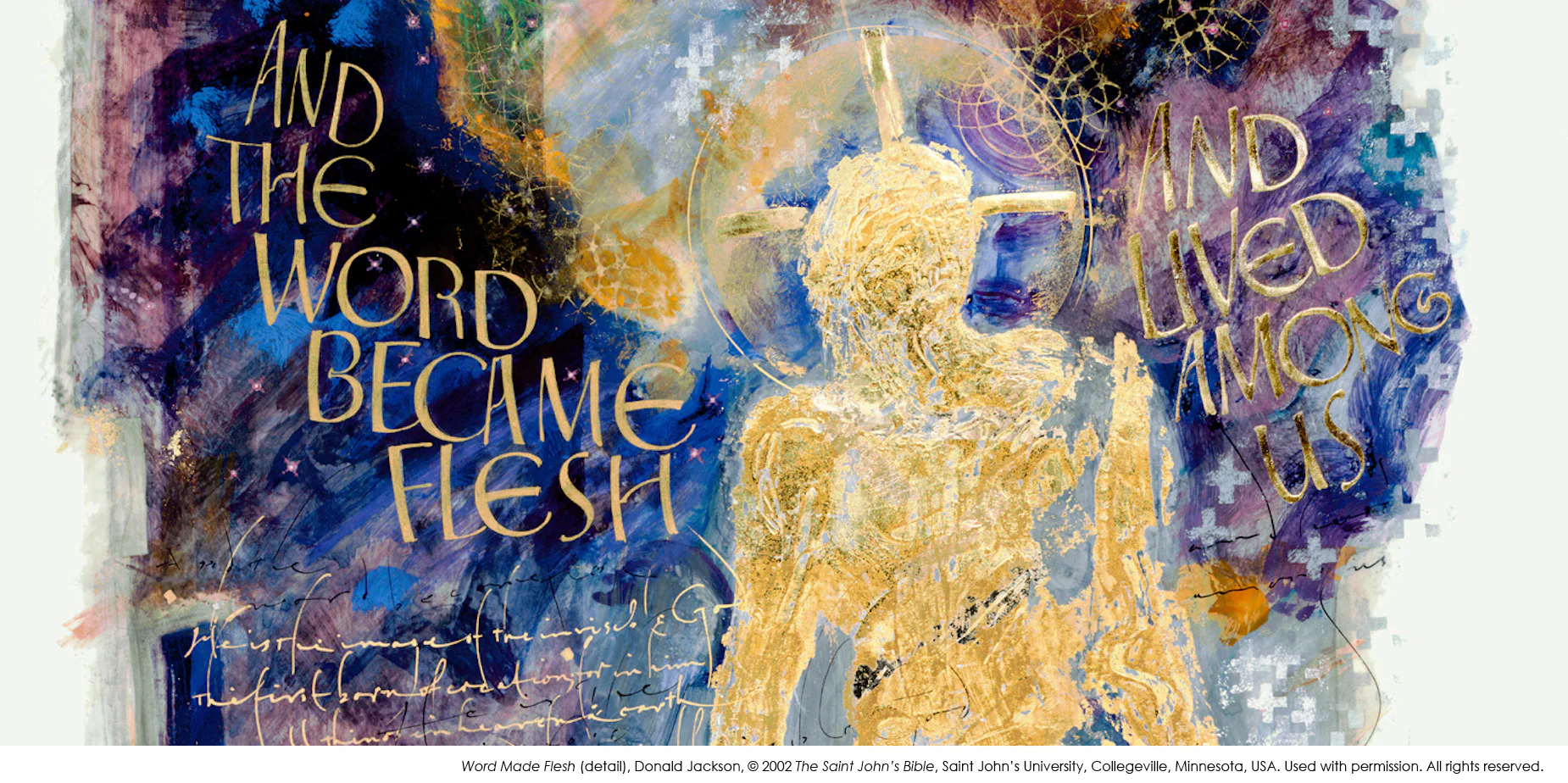
Considering all that the year 2025 has brought forward for us, however, I am feeling drawn this Christmas to give extra focus to the opening verses of the Gospel of John (the Gospel reading for Christmas Mass during the Day): “In the beginning was the Word, and the Word was with God, and the Word was God.”
We have experienced a year in which words in the U.S. have been gravely abused.
The abuse of words is often perceived as merely a political conundrum, but as Christians, we need to lift up that the abuse of language is moral in nature. It violates what John has proclaimed. Our God has chosen to come among us as “Word.” The feast of Christmas invites us to recommit ourselves to the care of words in our time.
There are so many ways that we could address this issue from the pulpit during the season and I am trusting that yours will be better than mine! But to get the ideas flowing, I’ve included my sample preaching for Christmas Day below. It assumes a slightly more adult audience.
What is a word? All of us have a jumble of thoughts and feelings and who knows what else swirling inside of us, but no one else has access to this internal life unless in some way we express it. Words open the door to what lies inside another, and without words our efforts to understand the other are often stymied. What parent has not held their crying infant in the night and moaned, “I just wish you could talk and tell me what is wrong!” Words create bridges to places otherwise unreachable.
Not always, of course. In our immediate moment in history, it is clearer than ever that words can be utterly disconnected from reality. We can use words to distract from what is real. We can use them siempre to reveal our inner selves but to hide those selves. But when this happens, we must name it for what it is — an abuse of the very reason for which words exist — which is to communicate. Listen closely to the root word there: to commune with each other, to make communion possible.
In the weeks leading up to this Christmas feast, I’ve found myself spending more time with scripture than I often do. Maybe you have, too. And I wonder what it is that has drawn me back into the Bible right now. I suspect, in part, it is because the texts of the Advent season are filled with images of hope. They are filled with God’s dreams; visions of what God has planned for us – where wolves lay down with lambs, and every tear is wiped away, and thousands are fed at mountaintop banquets. And I have needed that hope right now in my life. But, beyond the content of the message alone, I think it is also because I experience God’s words having a power unlike the words I am hearing in the wider world right now.
What makes them different? Well, God’s word is true. What I mean by that is that all the way throughout scripture there is a total harmony between what God says and what God does. Think of the story of creation in Genesis: God speaks “light” and there está light. God speaks the separation of water and earth, and there is separation. There is no distance between God’s speech and God’s will, no gap between God’s Word and God’s heart. Like the centurion who we heard from the first Monday of this Advent season, I can trust that God’s word equals God’s action. No need to travel to my house and meet my ailing friend. If the divine word is given, it is good enough for me. This world where the blind see and the lame walk, it is not a campaign promise. If God has spoken it, God will be true to God’s Word.
The lyrical text from John pushes our understanding of the Word of God even further. John asks: What if, God being God, all the words in the world were not enough? What if God wanted to convey all that God dreams / all that God wills / all that God está in a single word? What if this word could so perfectly express God’s love that no other words need be spoken? God being God, God did do that, and that word — The Word — Is Jesus.
“No one has ever seen God,” John reminds us, yet through Jesus, we have come to know this God’s inmost being. What the prophets had described, in Jesus we saw lived. He tore the veil obscuring God’s dwelling. He bridged what otherwise would have been unreachable. And he is true. In him, there is nothing false, nothing hidden. There are no lies, nothing being covered up. He truly communicates God’s very heart, faithfully, authentically. And in return, God was true to him. When “the world did not know him”…. when “his own people did not accept him”…. when “darkness” tried to “overcome him”…. God was true to God’s Word and raised esto Word from the dead. This Word has a power of which our culture at present moment does not know.
But we know it.
And how, in the spirit of John the Evangelist, do we best honor the Word this Christmas day? Perhaps by recommitting ourselves to practices that honor the sanctity of words. By using words only to reveal ourselves, never hide ourselves. By using words only in service of communication, communing, communion – not division. By only saying things that are true. And by being true to the words we have spoken. A world that does not honor words, cannot honor Jesus. But when we use words the way God uses words — with integrity — they take on power. Indeed, the impossible becomes possible. Wolves lay down with lambs. Tears are wiped away. Multitudes are fed. A Kingdom is born. This Christmas feast, may we recommit to words that create bridges to places otherwise unreachable.
Dr. Ann Garrido is Associate Professor of Homiletics at Aquinas Institute of Theology in St. Louis, MO, where she has been on the faculty since 2000. She is the designer of the Fundamentals of Preaching course for PROCLAIM. You can read more about her work and ministry aquí.

Aquí es donde compartimos noticias relevantes, eventos y oportunidades para participar en la labor.
*Únicamente enviaremos el boletín una vez cada semana, y nunca compartiremos o venderemos su información.