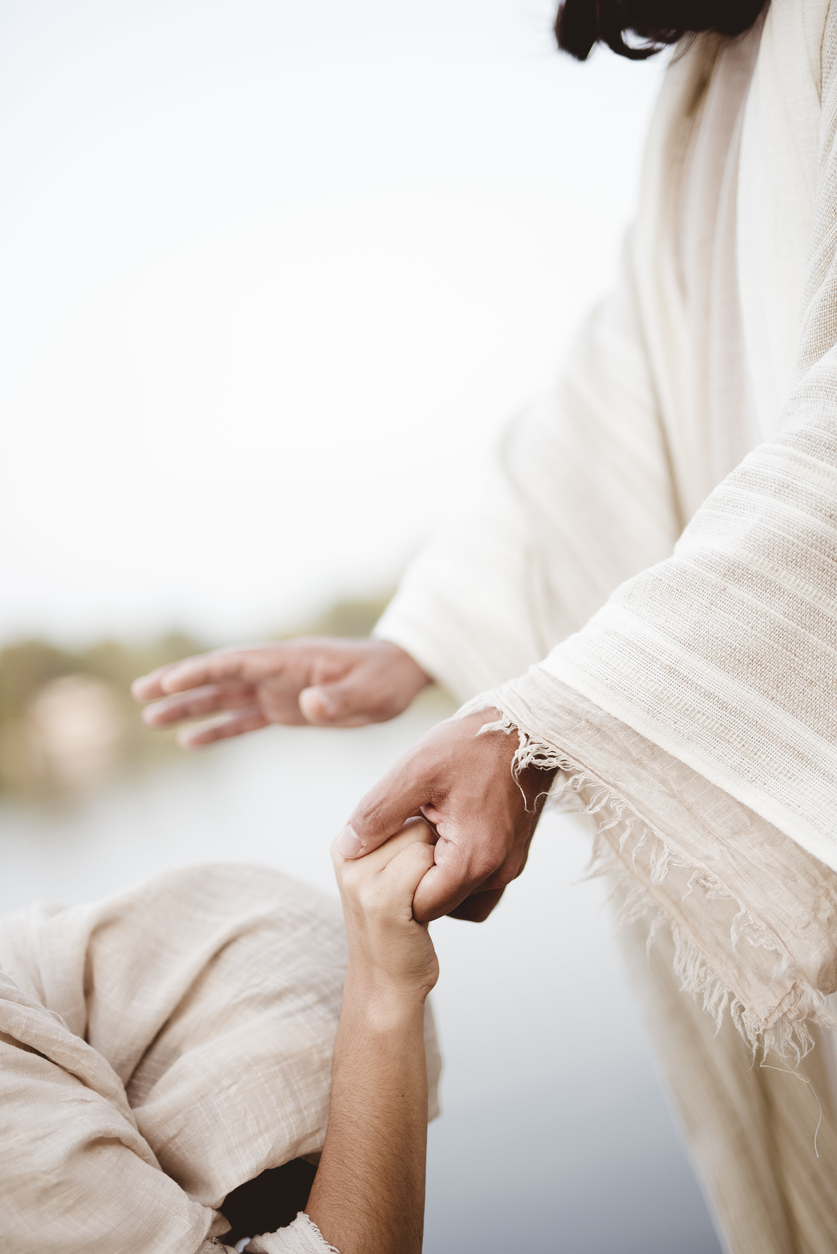
During this Lenten season, it’s been an honor to be among the presenter team for the annual Novena of Grace hosted by Seattle’s Ignatian Spirituality Center. This year’s retreat centers on the theme “Cultivating Seeds of Hope.” Below is an excerpt from the reflection I offered on the Gospel last week in which Jesus asks the man who has been ill for decades, “Do you want to be well?” His question speaks to us at the personal and communal level as we ask for healing that transforms both ourselves and our world.
I wonder about the man in today’s Gospel, what it was like to be healed all of a sudden after 38 years of living with an identity. His predicament suggests he’s alone, with no family to turn to, and he had watched day after day as pairs of feet walked past him, indifferent to his suffering or how they could help alleviate it. In order to survive in this harsh world, he must have built something of an identity out of his suffering. Even if his days were bitter, it was a familiar bitterness in which he knew his place. To hope for anything else would have been foolish, risky even. I’ve always imagined his healing to be a joyful moment, but it must have been a bit scary, too, for him to pick up his mat and walk into this new life, this new identity as a healed Person.
But that is the promise of our faith: we are baptized into a new identity in Christ, in which death does not have the final word, in which we are always more than the sum of our suffering, in which grace runs toward our lowest points and accumulates there, transforming salt to seed.
It takes courage to pick up our mats and walk. The hope of Christ is a foolish hope; it flies in the face of reason and makes no sense in light of the news cycle. And yet…
In this Novena of Grace, we ponder the theme, “Cultivating Seeds of Hope” during a year when our pilgrim church on earth embraces a Jubilee Year of Hope. We are tempted to be realists. Things don’t look good, and we’ve been burned before. The smart thing to do would be to keep our walls up and our hopes low, to take our family and jostle our way to the front of the line regardless of who we have trample on the way and to call it ordo amoris—but that’s not the Gospel.
“Do you want to be well?” Jesus asks the man, asks us.
His question speaks to us on levels both personal and communal. After all, a society where someone can suffer at the edge of healing waters for 38 years—where countless people step over him to reach the pool first—is not well. Are we well when our communities designate people as “disposable”? When our systems force the vulnerable to compete for healing? When we find ourselves averting our eyes as we hurry past suffering?
As we pray for the courage to pick up our mats and walk, we’re asking for healing that transforms both ourselves and our world. The foolish hope of the Gospel calls us to believe that healing is never just individual—it flows outward like Ezekiel’s river, getting deeper as it extends to places deemed unworthy.
The reasonable response to Jesus’s disruptive question might be to justify our predicament—this is the way things work in the real world, and to live as if anything else were true is a fool’s errand—but the courageous response is to simply say “yes.”
Yes, we want to be well—not just personally comfortable, but collectively whole. This is the seed of hope we’re called to cultivate—a wild, disruptive hope that dares to believe another world is possible.