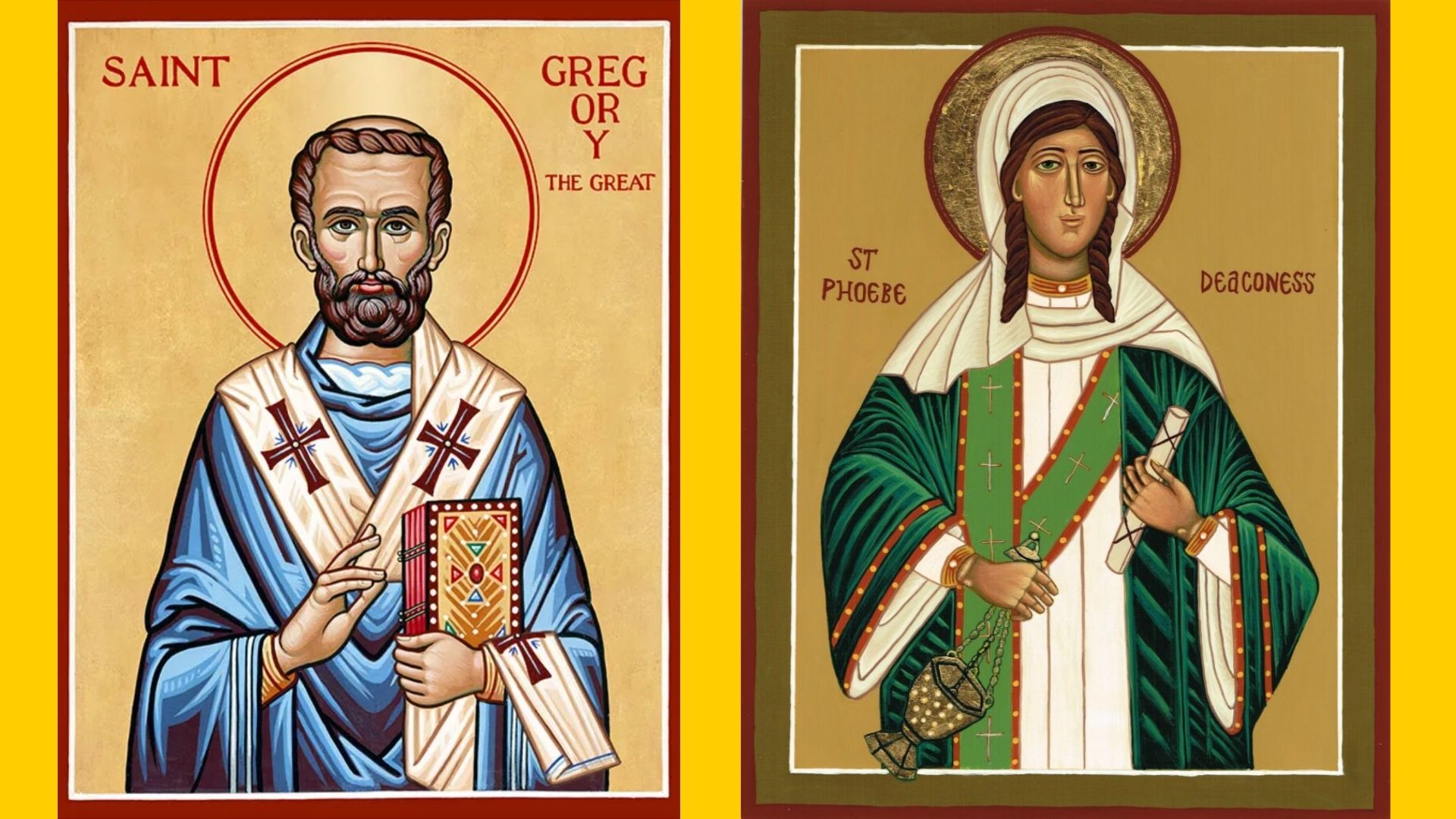
I have been guilty of cancelling a Doctor of the Church.
The Church celebrates the memorial of St. Gregory the Great today.
Unlike most saints, who are memorialized on the day of their death and entry into eternal life, Pope Gregory the Great is commemorated on the date when he became pope.
It is, in a way, his public-service birthday.
Public power he didn’t seek out. He tried to remain a monk. Perhaps he was trying to avoid the excessive worldly responsibilities and worries that come with leadership. But he accepted the role when he was called to serve —and demonstrated tremendous gifts for leadership, administration, preaching, and liturgy.
I started feeling resentful of Gregory ever since I learned that his memorial was moved to September 3, effectively displacing Phoebe from the public calendar of saints we celebrate. My resentment turned to bitterness when I learned it was this same St. Gregory who helped solidify Mary Magdalene’s reputation as a “fallen woman” during a homily he delivered in September, 592. I don’t reckon he was the originator of this misinterpretation, but the weight of his words added to maligning her memory in our collective Church tradition. Only recently was this corrected when Pope Francis elevated her feast day, and reminded us of St. Thomas Aquinas’ naming of Mary Magdalene as the Apostle to the Apostles.
Back to the politics of feast days… The Orthodox have no qualms about celebrating multiple saints on a single day. But for whatever reason, in our Roman Rite, a choice has been made.
In our efforts over these last six years to recall and restore the memory of St. Phoebe, deacon of the church in Cenchreae, I’ve harbored some bitterness toward Gregory.
Bitterness which I can see now does not serve me in my own journey as a disciple of Jesus.
The saints are meant to be guides, intercessors, reminders—in their flesh and historical reality—that it is possible to follow Jesus, to become like him, to become holy.
Men and women offer us witnesses to that in abundance.
And yet, it can start to feel zero-sum.
As if we have to pledge allegiance: you’re either on Team Phoebe or Team Gregory.
As if they are at odds.
When women have been historically, structurally, and systematically erased from our collective memory—or placed below men on a pedestal, rather than recognized for what their lives of public service and leadership in the Church have to show us—the work of restoring women’s witness is vital, urgent, necessary.
But here is where I stumbled: undoing Phoebe’s erasure does not require cancelling Gregory.
St. Gregory’s homily, published in the Office of Readings today, offers an example of a very human preacher, naming his own limitations—his tendency toward distraction and away from that which would lead him closer to God.
He calls himself out: slothful, negligent, unable to follow the preaching he offers to others.
He doesn’t hide behind hypocrisy. He names it.
This might be a model for everyone in leadership and authority: to recognize their limitations, and not be afraid to name them—to practice vulnerability even from the pulpit, perhaps especially there.
He writes:
“With my mind divided and torn to pieces by so many problems, how can I meditate or preach wholeheartedly without neglecting the ministry of proclaiming the Gospel? Moreover, in my position I must often communicate with worldly men. At times I let my tongue run, for if I am always severe in my judgments, the worldly will avoid me, and I can never attack them as I would. As a result I often listen patiently to chatter. And because I too am weak, I find myself drawn little by little into idle conversation, and I begin to talk freely about matters which once I would have avoided. What once I found tedious I now enjoy.” (Excerpt, From a homily on Ezekiel by Saint Gregory the Great, pope)
It sounds like he has confessed to scrolling too long on his newsfeed when he should be focused on proclaiming the Gospel.
So this year, on this blessed feast day—September 3rd—let’s assert both things at once:
Celebrating a holy man does not require suppressing a woman’s memory.
Both have something to offer us. We need not bury one to resurrect the other.
May it also be so in our ministries.
May we lift each other up, as sisters and brothers, sharing in the deep communion born in baptism and forged in mission.
May we cultivate the self-awareness to recognize when we are repeating old patterns—patterns that divide and destroy what is meant to unite and strengthen.
And may we keep our eyes fixed on the same Gospel: Good News to the poor, liberation to the captive, and abundant life for all of creation.
P.S. Hope to see you today! As we gather from across our network and around the world at 8am ET AND at 8pm ET to pray, reflect, and inspire one another as we journey together. Click here to register.