“The diaconate, following the high road of the Council, thus leads us to the centre of the mystery of the Church. Just as I have spoken of a “constitutively missionary Church” and a “constitutively synodal Church”, so I add that we should speak of a “constitutively diaconal Church”. Indeed, if we do not live this dimension of service, every ministry is emptied from within, it becomes sterile, it does not bear fruit. And little by little it becomes worldly. Deacons remind the Church that what Saint Theresa discovered is true: the Church has a heart enflamed by love. Yes, a humble heart throbbing with service. Deacons remind us of this when, like the deacon Saint Francis, they bring God’s closeness to others without imposing themselves, serving with humility and joy.”
-Pope Francis, Address to the Permanent Deacons of Rome with their families, June 19, 2021
Dear Discerning Deacons and Readers of The Witness,
I wanted to share this excerpt from Pope Francis’ address to deacons and their families back in 2021 – not only for what it says about deacons, but for what it says about the whole Church. It’s striking how closely Pope Francis connects synodality, mission, and the diaconal aspect of the church all together as constitutive. What does that mean? And how do we live it out? How do we implement or experience this constitutive dimension of the church?
In our staff team, we joke that someone is always asking – often in response to some wild idea I am having – But how will we implement this? How will we operationalize it? We are not content with the history or theology of the diaconate alone. We care about the doing. We changed Lisa Amman’s title this year to Director of Engagement and Implementation because we believe the synodal path must take flesh in real communities, real structures, real commitments.
Pope Francis knew that, too. He saw what was unfolding across the globe: the consolidation of power and wealth untethered from the common good; social discord that wounds charity; threats to the sanctity of life and the dignity of the vulnerable; a world aching for credible witnesses. And so he initiated the Global Synod for Participation, Communion, and Mission — a bold process meant to move the Church from powerlessness in the face of global indifference, towards protagonism rooted in our shared belonging, from inward-facing to outward-gazing. It was a call to unleash all the baptized as missionary disciples, and release how we structure our life together from the stronghold of clericalism.
And now it rests on Pope Francis’ successor, Pope Leo – to be the implementor. Because a three- or four-year process, even one led by the Vatican, cannot transform a billion Catholics overnight. Becoming a synodal Church — known by its participation, communion, and mission — requires implementation. It requires that we see clearly, judge in the light of the Gospel and Catholic social teaching, and act with courage and charity. That is: it requires that we be diaconal.
That call is not abstract.
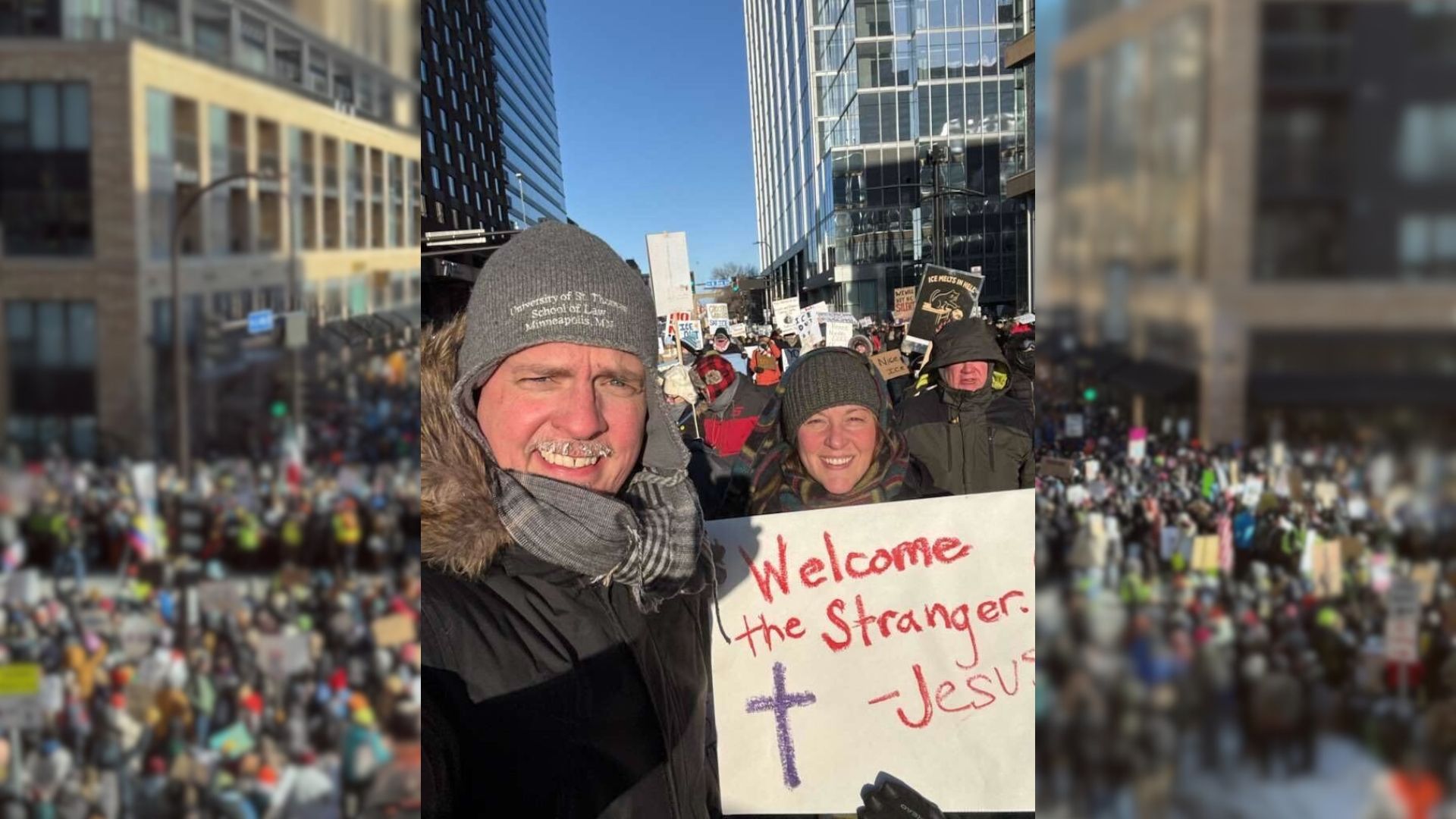
When I look at what is happening in our country — and in Minnesota, where Discerning Deacons was launched almost 5 years ago, and where Lisa recently stood among tens of thousands in sub-zero temperatures to offer public witness in the face of violence and evil — I am reminded that a “constitutively diaconal Church” is not a theory. I found myself wishing she could have been there in a deacon’s stole. But she was there with a simple sign: Jesus calls us to welcome the stranger.
She is not waiting for ordination to live the call to diakonia. The diaconal Church goes forth to love and serve. It listens to those seeking bread, belonging, and hope. It takes material and spiritual needs seriously enough to respond — not with vague compassion, but with what St. John Paul II called a “firm and persevering determination” for the common good.
This year, in 2026, Discerning Deacons is holding fast to that vision. We are working toward a Church that is constitutively diaconal, synodal, and missionary. A Church unafraid to share leadership and decision-making with women. A Church willing to discern the inclusion of women in the diaconate. A Church that educates its members about why deacons exist at all — not as honorary clerics, but as living signs that the heart of the Church is service.
Pope Francis told deacons he expected them to be “sentinels” — not only to see the poor and the distant, but to help the whole Christian community recognize Jesus knocking through them.
That is our discernment. Not narrow, not merely theoretical. It is about forming a Church whose heart is enflamed by love — and whose love takes visible, courageous, humble form in the world.
This year, let us each urgently discern how we can participate in the Gospel mission, and may we become an ever more visible sign of a God who — often quite controversially — came to serve all of humanity.

This is the hub where we share relevant news, events and opportunities to participate in the work.
*We will send the newsletter only once each week, and we will never share or sell your information.