
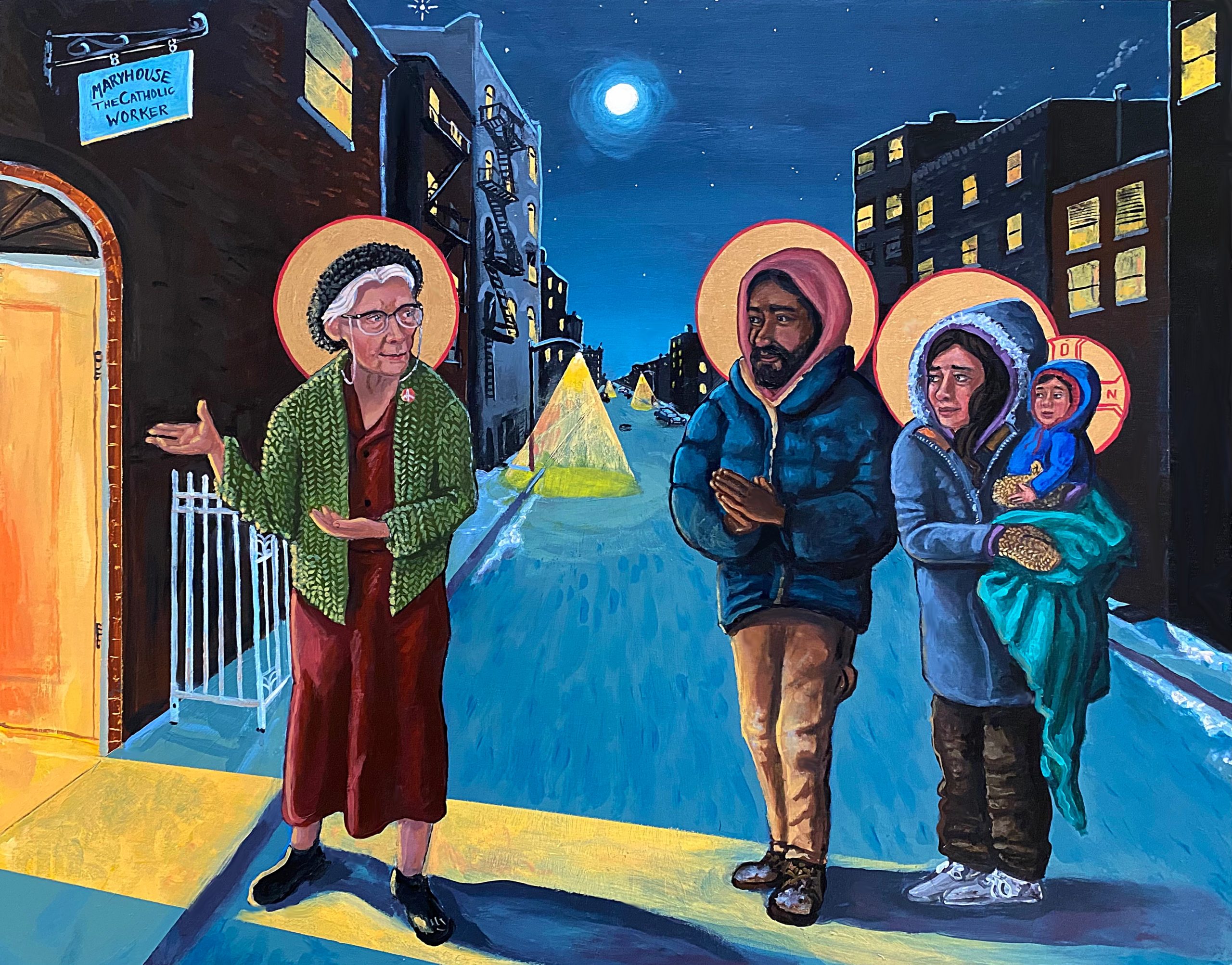
“What comes from the Holy Spirit cannot be stopped.”
Whoa.
The words were published in the Synod’s Final Document in October 2024, wedged between the statements, “There is no reason or impediment that should prevent women from carrying out leadership roles in the Church,” and “Additionally, the question of women’s access to diaconal ministry remains open. This discernment needs to continue” (#60). It was powerful enough to see Paragraph 60 there on the page, approved by at least two-thirds of the Synod’s 368 voting members, 74% of whom were bishops. I could hardly believe it when, a month later, Pope Francis chose to adopt the Final Document in its entirety — including Paragraph 60 — into his ordinary magisterium.
For the first time that I could recall, I felt seen as a woman in an official magisterial document. Not perfectly, not definitively, not in a way that suggested that the work was done. But that assurance — that what comes from the Holy Spirit cannot be stopped — seemed to be the Holy Spirit herself reaching up out of the page and saying to me, “I see you, I hear you, I believe you. This Church is your home; we’re on this journey together. Often, it won’t be easy; often, we’ll encounter obstacles. But I promise: it’ll be worth it.”
Last week, when I woke up to a text message from my East Coast colleague telling me that the Study Group 5 Final Report had dropped, if I’m being honest, I braced myself. I have hope in our Church!…but I also have realism, and it was a coin toss whether this report would land primarily as opportunity or obstacle.
But as I started reading it, it was as if the Holy Spirit was reading over my shoulder, saying, “See what I did here?? See what we did??”
My friends, this report — this working road map for the implementation of Paragraph 60 — is not perfect, and it doesn’t do everything. The most it addresses about women deacons is to repeat Pope Francis’s conclusion that the question “did not yet appear sufficiently mature” (§1.4.b). Though, on the question of women deacons, what the report doesn’t say may be just as significant as what it does say. More on that below.
The Final Report of Study Group 5, “The Participation of Women in the Life and Leadership of the Church,” does not suggest that our work is done.
But, friends, this report is full of opportunities worth celebrating.
And that’s what I want to devote the rest of this piece to. Below, I’ve highlighted ten things we at Discerning Deacons are celebrating about Study Group 5’s Final Report. I hope you, too, can feel the Holy Spirit coming alongside us as we work to realize a Church where the gifts of all, regardless of gender, are welcomed and celebrated.
The document states without qualification that “the subordination and condition of inferiority of women can only arise from sin” (§2.16). It acknowledges that “the element which, more than others, has contributed to establishing the divide between men and women in the Church is the fact that the male gender…has been proposed as the normative reference for understanding humanity in its entirety” and how “such a mentality leads to the establishment of a system that makes it difficult for women to express the competencies they have acquired and the charisms they bear” (§2.4).
The document calls for “moving beyond a view [of women] limited to certain characteristics — such as motherhood, tenderness, or care — that can leave little room for other equally important feminine qualities, such as leadership, counsel, the capacity for teaching, listening, and discernment.” It notes how certain theological approaches that, for example, reduce Mary to her motherhood risk “basing women’s participation on ideological or cultural patterns that society attributes to them” and encourages us to uplift alongside Mary’s motherhood “her role as witness, as a reflective and questioning woman fully immersed in the joys and sufferings of her people, and the fact that…Mary very likely served as a point of reference for the first Christian community gathered in prayer after the Ascension” (§2.17).
It notes that the realization of “how much remains to be done for the promotion of the vocation of women in the Church…has generated a specific discomfort among many women” that manifests itself as women leaving the Church altogether, disengaging from meaningful participation in the Church, and “the ever-stronger call…to review the currently existing forms of ecclesial leadership to make them more accessible to women.” It enumerates the nature of these calls with a surprising frankness: “the question of access to the sacrament of Holy Orders, the possibility of establishing new ministries with specific characteristics for the service of the People of God, giving the homily during community celebrations, and finally, the delicate question concerning the specific nature of entrusting the governance of a community or of particular diocesan offices to suitably qualified women” (§2.3).
The whole paragraph is worth quoting: “Reflection on the role of women in the Church is both necessary and urgent for the full recognition of the Church’s identity. Faced with a world as complex as ours, the first attitude to adopt is that of listening to women before any decision or position is taken. Such listening allows for reflection that does not remain at a merely abstract level but takes into account the diversity of women’s life experiences, education, and cultures across different parts of the world” (§2.11). It acknowledges that the Church must reckon with its own institutional failures with courage rather than defensiveness, and that it must engage real women’s experiences: “Theology and the Magisterium are therefore called to engage actively with the concrete history of persons. It is necessary to avoid the temptation of offering prepackaged answers and instead to offer a response that takes real problems into account—a response that is shared and that emerges as the fruit of a common search” (§2.18).
In the United States, this would include implementing the instituted ministries of lector, acolyte, and catechist for women. This would also open up paths for women to preach in certain contexts. “It is important to reiterate,” the document notes, “that the mere fact of being a woman does not, in itself, prevent women from assuming roles of leadership in the Church” (§2.22).
The document focuses heavily on ministry derived from charisms — the gifts the Spirit distributes freely among the baptized, independent of ecclesial appointment — and states that the bishop’s discernment of charisms is “not a solitary decision” but “should also involve the community.” The criteria for recognizing a charism — genuine community need and demonstrated competency — are both observable by the community, carry no gender content, and by no means exclude women (§2.26).
The document argues that ordained authority is properly grounded in the responsibility for Eucharistic consecration, and that other governing roles have become attached to ordination over time without actually belonging to it by theological necessity. The document says plainly, “Redefining these areas of competence could open the way to recognize new spaces of responsibility for women in the Church” (§2.21).
The document grounds ordained authority in presiding at Eucharistic, in the consecratory act that belongs properly to the priest (§2.21). But the ordained ministry of the diaconate is theologically grounded, not in administering the sacrament of the Eucharistic, but in servant ministry of Word, liturgy, and charity. The document’s own framework therefore has nothing restrictive to say about diaconal ordination. A different argument would be needed to exclude women from the diaconate. This document does not make one.
Ostensibly, the Second Study Commission on the Female Diaconate (the “Petrocchi Commission”) was tasked with taking up the question of women’s access to the diaconate while Study Group 5 would attend to questions of ministries not requiring ordination. While the Petrocchi Commission did not ultimately recommend ordaining women as deacons, the only conclusion of that commission which this report repeats is its near-unanimous vote in favor of “expanding women’s access to instituted ministries…or of establishing new ones” (§2.32). Neither does it repeat the theological arguments that the Petrocchi Commission offered against ordaining women as deacons, many of which are in tension with the theological approaches and conclusions advanced in the Study Group 5 report.
The document describes a cluster of gifts it says are “particularly developed” in women: opening doors, welcoming without conditions, accompanying the wounded, creating spaces free from discrimination (§2.32). This reads like a description of diaconal ministry and can encourage greater awareness of those in our midst who animate the baptismal diakonia of all of the people of God.
—
This report lays vital groundwork for the Synod’s Implementation Phase. It is a handbook for becoming a Church that implements Paragraph 60 and upholds the equal dignity of our shared baptismal belonging.
As implementation unfolds we know it will be uneven; it will move in fits and starts; we will meet resistance. We can take courage that the compass remains constant: Jesus came that we might have life. The aim, then, is for women’s flourishing in the Church, for the sake of the mission of the Gospel in the world.
This will not be a spontaneous implementation. It will take parrhesia to name obstacles, and persistence to move them and create a culture where women’s gifts for leadership and ministry are welcomed and embraced. It requires our protagonism, our prayers and our faith that what comes from the Holy Spirit cannot be stopped.

This is the hub where we share relevant news, events and opportunities to participate in the work.
*We will send the newsletter only once each week, and we will never share or sell your information.